


This guide provides a comprehensive framework to help you select and implement a secure national infrastructure. We examine the methods to unify your security posture and build a resilient environment that supports advanced AI and custom software development. We'll explore the implications of the National Cyber Accreditation Programme and the transition toward mandatory resilience standards. By the end of this article, you'll have a clear roadmap to transform your security from a compliance burden into a scalable foundation for long-term growth and technical stability.
Key Takeaways
- Understand the evolution toward sovereign multi-cloud environments and how national data residency laws are redefining infrastructure standards.
- Learn to evaluate cloud security solutions UAE using a strategic framework focused on unified visibility and governance across diverse platforms.
- Determine whether to implement managed security services or invest in bespoke architecture designed for specific custom software requirements.
- Gain clarity on the regulatory requirements set by the UAE Cybersecurity Council and DESC to maintain full compliance with national frameworks.
- Discover how to future-proof your digital assets by integrating DevSecOps and AI-driven automation into your security strategy.
The State of Cloud Infrastructure in the UAE for 2026
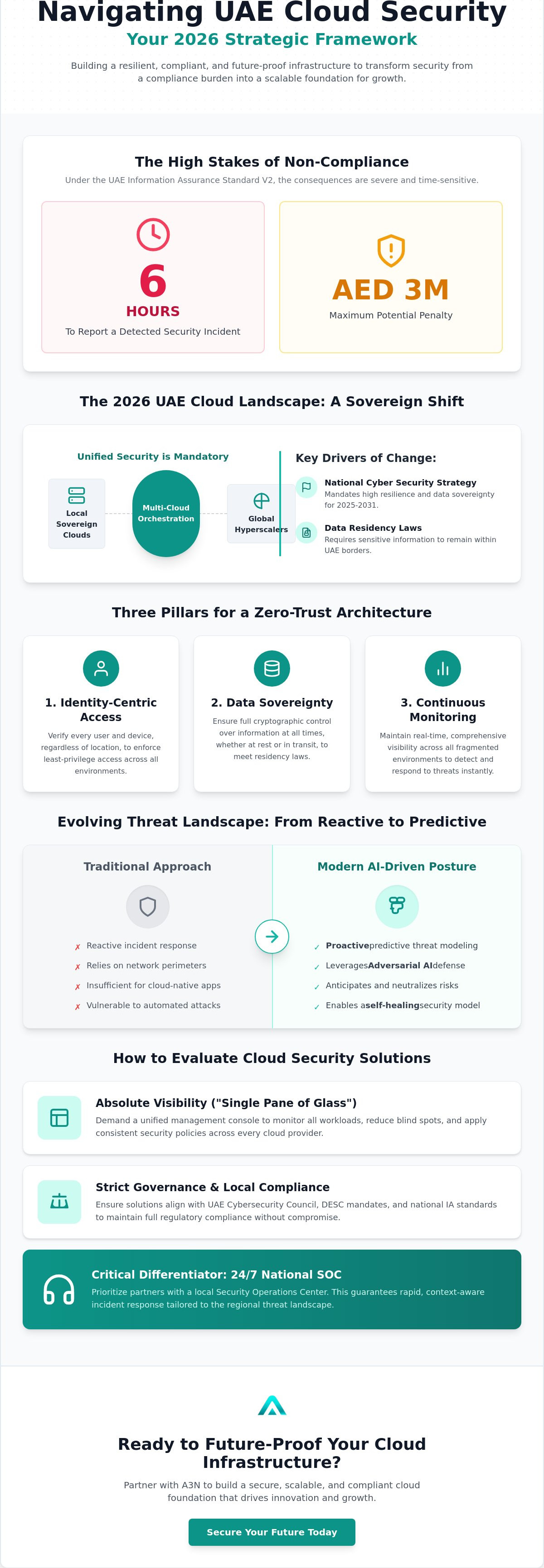
The UAE digital landscape in 2026 is defined by a decisive transition toward sovereign multi-cloud environments. Enterprises no longer rely on a single provider; they orchestrate workloads across a sophisticated mix of local sovereign clouds and global hyperscalers. This shift isn't merely a technical preference. It's a strategic response to the UAE National Cyber Security Strategy (2025-2031), which mandates high levels of resilience and data sovereignty. As organizations scale, the demand for robust cloud security solutions UAE has intensified, specifically to address the complexities of managing data across these diverse territories.
The primary driver behind this architectural change is the rigorous enforcement of national data residency laws. These regulations require that sensitive information remains within the borders of the Emirates, necessitating a security posture that is both agile and strictly compliant. In this environment, implicit trust has become the greatest vulnerability. Relying on the assumed safety of a network perimeter is no longer viable when digital transformation occurs at a national scale. Security must now be defined by three core pillars:
- Identity-Centric Access: Verifying every user and device regardless of location.
- Data Sovereignty: Ensuring cryptographic control over information at rest and in transit.
- Continuous Monitoring: Maintaining real-time visibility across fragmented environments.
Sovereign Cloud vs. Global Hyperscalers
Choosing between local UAE data centers and global providers like AWS or Azure is no longer a binary decision. Modern organizations utilize both to balance low-latency performance with global scalability. However, securing these disparate environments requires a unified framework. Effective cloud computing security identifies that data must be protected consistently, regardless of where it resides. National security standards now dictate that cloud provider selection must prioritize transparency and alignment with local Information Assurance (IA) standards, ensuring that workloads are shielded from cross-border legal and technical risks.
AI-Driven Threat Landscapes
By 2026, the threats targeting UAE infrastructure have become largely automated. Adversarial AI now launches sophisticated, multi-vector attacks that can identify and exploit vulnerabilities faster than any human team. Traditional firewalls and reactive measures are insufficient for today's cloud-native environments. To stay secure, businesses are transitioning to proactive postures that leverage predictive threat modeling. This approach uses AI to analyze patterns and neutralize risks before they manifest, moving beyond simple automation to a self-healing security model. Implementing advanced cloud security solutions UAE ensures that your infrastructure doesn't just respond to attacks but anticipates them, maintaining operational continuity in an increasingly volatile digital world.
Essential Criteria for Evaluating Cloud Security Solutions in the UAE
Selecting the right cloud security solutions UAE requires a structured approach that balances rigorous protection with operational agility. A robust framework focuses on three essential pillars: absolute visibility, strict governance, and adaptive protection. These elements ensure that your infrastructure remains resilient against evolving threats while maintaining compliance with local standards. Without a clear selection framework, organizations risk adopting fragmented tools that create more complexity than they resolve.
Managing a multi-cloud environment without centralized control leads to dangerous security gaps. A "Single Pane of Glass" management strategy provides a unified view of your entire digital estate. It allows your security teams to monitor workloads across various providers from a single interface, reducing the risk of overlooked vulnerabilities. This centralized approach streamlines reporting and ensures that security policies are applied consistently across every cloud instance.
In the Emirates, the presence of a 24/7 national Security Operations Center (SOC) is a critical differentiator. Local expertise ensures that incident responses are tailored to regional threat patterns and specific UAE regulatory requirements. This proximity accelerates remediation and strengthens trust with local stakeholders. Your security must also scale alongside your business. Whether you're launching new mobile apps or expanding custom software, your chosen solution should accommodate rapid user growth without compromising performance. Partnering with experts in cybersecurity solutions ensures your defense mechanisms are built into the foundation of your digital growth.
Unified Visibility and Governance
Cloud Security Posture Management (CSPM) serves as an automated guardian, identifying misconfigurations in real-time before they can be exploited. Complementing this is Identity and Access Management (IAM), which utilizes granular, role-based controls to ensure that only authorized entities access sensitive data. Within the context of UAE enterprise scalability, CSPM acts as a continuous validation layer that ensures every new cloud instance adheres to national security benchmarks from the moment of deployment.
Performance and Integration
Security should never be a bottleneck for user experience. Poorly integrated tools can increase application latency, frustrating mobile app users and slowing down business processes. An API-first security approach is essential for seamless integration with custom web and mobile applications, allowing security protocols to function as part of the software logic rather than an external layer. Organizations must weigh the benefits of native cloud security tools against third-party enterprise platforms. While native tools offer ease of use, third-party platforms often provide the cross-cloud consistency required for complex, sovereign multi-cloud architectures.
Managed Security Services vs. Bespoke Cloud Architecture
Organizations face a pivotal decision when scaling their digital operations: should they adopt standardized managed services or invest in a bespoke security architecture? This "build vs. buy" dilemma is particularly acute in the Emirates, where diverse regulatory requirements meet ambitious digital growth. For many, the choice depends on the complexity of their proprietary systems. While standardized cloud security solutions UAE provide an excellent baseline for common applications, they often lack the granularity required for complex, custom-built software environments. A visionary approach recognizes that security isn't a one-size-fits-all utility but a strategic asset tailored to your specific business logic.
Modern Managed Detection and Response (MDR) has evolved to meet the demands of 2026, offering national-level threat hunting that goes far beyond simple alert monitoring. These services leverage external expertise to identify adversarial patterns that internal teams might miss. However, the most resilient organizations often adopt a hybrid model. This strategy combines the agility of internal DevOps teams with the deep specialized knowledge of external cybersecurity consultants. It ensures that security is integrated into the continuous delivery pipeline rather than being treated as an afterthought.
The Case for Managed Security
Managed services offer an immediate path to sophisticated protection without the significant overhead of internal hiring. By utilizing a provider with a 24/7 national SOC presence, businesses gain access to high-level talent and advanced AI-automated threat response capabilities. This model transforms unpredictable security costs into manageable operational expenses. It allows your internal IT staff to remain focused on core product innovation while experts handle the constant vigilance required to maintain a secure infrastructure. This partnership provides the stability needed to scale rapidly in a volatile digital environment.
Bespoke Architecture for High-Compliance Sectors
High-compliance industries like fintech and logistics require a higher degree of architectural precision. These sectors often handle unique data flows that demand custom encryption and specific data masking protocols to meet UAE-specific privacy standards. Bespoke security architecture addresses these needs by building protection directly into the software's DNA. At A3N, we integrate security considerations into the initial UI/UX and software design phases. This proactive methodology ensures that your cloud security solutions UAE are perfectly aligned with your application's functional requirements, creating a seamless and secure user experience from the very first line of code.
Navigating UAE Cybersecurity Compliance and Standards
Compliance in the UAE has transitioned from a collection of recommended guidelines to a strict legal mandate. The UAE Cybersecurity Council (CSC) and the Dubai Electronic Security Center (DESC) act as the primary governing bodies, enforcing standards that protect the nation's digital sovereignty. For organizations evaluating cloud security solutions UAE, alignment with the UAE Information Assurance (IA) Standard V2 is no longer optional. This framework requires immediate action, including a six-hour incident notification deadline that demands a highly responsive technical architecture. Failing to meet these requirements can result in significant financial penalties, which reach up to AED 3 million under the latest 2026 enforcement protocols.
Data residency remains a cornerstone of these regulations. Businesses must ensure that sensitive personal data and critical information infrastructure stay within national borders. This requirement reshapes how workloads are distributed across cloud environments. It forces a move away from generic global configurations toward localized, compliant setups. Performing a thorough audit is the first step toward achieving this regulatory readiness. It isn't just about avoiding fines; it's about building a foundation of trust that enables long-term growth.
Compliance as a Competitive Advantage
Achieving full compliance builds indispensable trust with both government entities and corporate clients. It transforms a legal necessity into a powerful market differentiator. Organizations that proactively prepare for sector-specific audits in finance, healthcare, or energy demonstrate a level of maturity that attracts high-value partnerships. Utilizing automated compliance monitoring tools allows teams to maintain this posture continuously. This automation ensures that your infrastructure remains secure between formal audit cycles. To ensure your business meets these rigorous standards, you can leverage professional cybersecurity solutions tailored to the UAE regulatory environment.
The Audit Roadmap
Establishing a clear path to compliance requires a methodical approach. Follow these four essential steps to ensure your cloud environment is ready for inspection:
- Step 1: Data Classification and Mapping. Identify all data types and track exactly where cloud workloads reside to ensure residency compliance.
- Step 2: Gap Analysis. Compare your current security controls against the UAE IA Standard V2 and DESC ISR v3.1 requirements to identify vulnerabilities.
- Step 3: Control Implementation. Deploy missing technical and administrative controls while documenting every process for future verification.
- Step 4: Continuous Monitoring. Transition to a state of constant vigilance with periodic third-party assessments to validate your resilience and readiness.
Future-Proofing Your Cloud Infrastructure with A3N
Building a resilient digital presence requires more than just reactive monitoring. At A3N, we believe that security is an architectural discipline that must be woven into the very fabric of your code. By integrating DevSecOps principles, we ensure that every update and new feature is validated against rigorous security standards before it ever reaches the cloud. This proactive philosophy eliminates vulnerabilities at the source, providing a level of protection that external security layers alone cannot achieve. As you look toward 2026, the complexity of your digital products demands cloud security solutions UAE that are as dynamic as the software they protect.
We leverage advanced AI and automation to create self-healing cloud environments. These systems don't just detect threats; they automatically remediate misconfigurations and isolate suspicious traffic in real-time. This level of automation is essential for maintaining the six-hour notification window mandated by the UAE Information Assurance Standard V2. A3N stands as a strategic partner for national brands, providing the technical depth needed to scale complex digital products without sacrificing stability or compliance. Moving from a broad assessment to a secure, scalable deployment is the logical progression for any organization committed to excellence.
The A3N Security Advantage
Our deep expertise in custom software and mobile app development informs every aspect of our security strategy. We understand the specific data flows and logic patterns that make high-traffic applications vulnerable. For example, when securing high-traffic mobile apps, we implement tailored cloud infrastructure that optimizes performance while enforcing strict encryption protocols. This dual focus on speed and safety directly supports the UAE's national digital transformation goals, ensuring that the country's digital economy remains both innovative and secure. Our commitment is to provide the reliability you need to grow with total confidence.
Ready to Secure Your Digital Future?
Transitioning to a future-ready infrastructure requires a clear, actionable roadmap. Our team of experts provides customized cloud security solutions UAE for both established enterprises and rapidly growing firms. We take full ownership of the technical landscape, allowing you to focus on your core business growth. Whether you're planning a full-scale cloud migration or looking to optimize your existing security posture, we offer the guidance and execution needed to succeed. We invite you to consult with our specialists to develop a security strategy that aligns with your specific business journey.
Secure your cloud infrastructure with A3N today and build a foundation that is ready for the challenges of tomorrow.
Securing Your Competitive Edge in a Sovereign Digital Economy
The evolution of the Emirates' digital landscape has transformed protection from a perimeter defense into a fundamental architectural requirement. Organizations that successfully navigate this shift recognize that sovereign multi-cloud environments and rigorous compliance frameworks are the pillars of long-term stability. By prioritizing unified visibility and integrating security into the initial software design, businesses create a resilient foundation that supports both rapid innovation and national data residency mandates. This strategic alignment ensures that technical complexity never hinders your operational momentum.
Selecting the right cloud security solutions UAE ensures your infrastructure is not just defended but optimized for future growth. A3N provides the expert guidance needed to bridge the gap between complex custom software and robust cybersecurity. Our methodology combines deep expertise in custom DevSecOps with comprehensive UAE compliance knowledge and AI-driven infrastructure optimization. This partnership allows you to focus on your core business goals while we take full ownership of your technical security landscape.
Partner with A3N for Advanced Cloud Security Solutions and transform your infrastructure into a secure, scalable asset that drives your business forward. Your digital journey is full of potential, and with a dependable expert at your side, your path remains clear and protected.
Frequently Asked Questions
What are the primary cloud security regulations for businesses in the UAE?
The regulatory landscape is anchored by the UAE National Cyber Security Strategy (2025-2031) and the Personal Data Protection Law (PDPL). Businesses must also adhere to the UAE Information Assurance (IA) Standard Version 2, which mandates specific resilience controls and a six-hour incident notification window. These frameworks transition cybersecurity from a voluntary guideline to a mandatory requirement for all organizations processing resident data.
How does cloud security differ for multi-cloud vs. single-cloud environments?
Single-cloud environments often rely on native tools provided by the host, but multi-cloud strategies require a unified management layer to eliminate fragmented visibility. Implementing cloud security solutions UAE in a multi-cloud context involves using a "single pane of glass" to enforce consistent policies across different providers. This prevents security gaps that occur when disparate systems don't communicate effectively.
Can cloud security solutions in the UAE help with NESA compliance?
Yes, modern security solutions are specifically engineered to align with NESA standards, now overseen by the Signals Intelligence Agency (SIA). These tools provide the necessary technical controls, automated reporting, and continuous monitoring required to satisfy the UAE IA Standard V2. They ensure that your infrastructure meets the rigorous benchmarks set for national digital resilience.
What is the role of data residency in UAE cloud infrastructure?
Data residency dictates that sensitive personal information and critical infrastructure data must be stored and processed within the UAE's physical borders. This requirement ensures compliance with the PDPL and protects data from cross-border legal risks. Organizations must select cloud providers with local data centers to maintain sovereignty over their digital assets.
How much does cloud security consulting typically cost for a UAE enterprise?
Consulting costs depend entirely on the complexity of your custom software, the scale of your cloud environment, and your specific compliance needs. Every enterprise requires a tailored roadmap to address its unique technical landscape and growth objectives. It's best to request a customized assessment to determine the investment required for a secure and scalable infrastructure.
Is native security from AWS or Azure enough for UAE government-linked entities?
Native tools from global hyperscalers provide a solid foundation but are often insufficient for government-linked entities (GLEs) that must meet specific sovereign cloud requirements. GLEs typically require additional bespoke architecture and localized SOC support to satisfy the Dubai Electronic Security Center (DESC) and Cybersecurity Council mandates. A localized approach ensures all national security standards are fully addressed.
What is Zero Trust and why is it essential for UAE businesses in 2026?
Zero Trust is a security model that assumes no entity is trusted by default, requiring continuous verification for every access request regardless of its origin. It's essential in 2026 because traditional perimeters can't defend against sophisticated, AI-driven threats or secure decentralized workforces. This approach minimizes the attack surface and ensures that your cloud security solutions UAE remain effective in a boundaryless digital environment.
How does A3N integrate cybersecurity into custom software development?
A3N utilizes a DevSecOps philosophy to build security directly into the application's code during the initial design and development phases. We ensure that protection isn't an afterthought but a core functional feature of your software. This methodology supports rapid scalability and high performance while maintaining a robust defense against evolving digital threats.