


This article provides a clear roadmap for mastering the most significant shifts in the Apple ecosystem for the coming year. You'll discover how to leverage on-device machine learning and privacy-first engineering to build resilient, future-ready systems that respect user data. We will outline a strategic path for adopting Apple's latest frameworks while identifying the qualities of a reliable development partner who can protect your digital assets and accelerate your growth. Our goal is to ensure your organization remains a stable and visionary force in an increasingly sophisticated digital economy.
Key Takeaways
- Understand the transition of the Apple ecosystem into a unified platform where Swift 6 provides the foundation for secure, concurrent, and high-performance enterprise applications.
- Learn how to deploy Apple Intelligence to meet consumer demand for predictive features while ensuring sensitive data remains protected through sophisticated on-device processing.
- Navigate the complexities of 2026 App Store Privacy Manifests to ensure your mobile strategy remains fully compliant with national cybersecurity standards and data protection laws.
- Adopt "Spatial Design" principles to create immersive, premium user experiences that leverage haptic feedback and sound design to build a distinct digital identity.
- Identify a strategic roadmap for scaling your iOS app development by integrating AI and automation into your existing technical infrastructure with a dependable partner.
The Evolution of iOS App Development: Navigating the 2026 Landscape
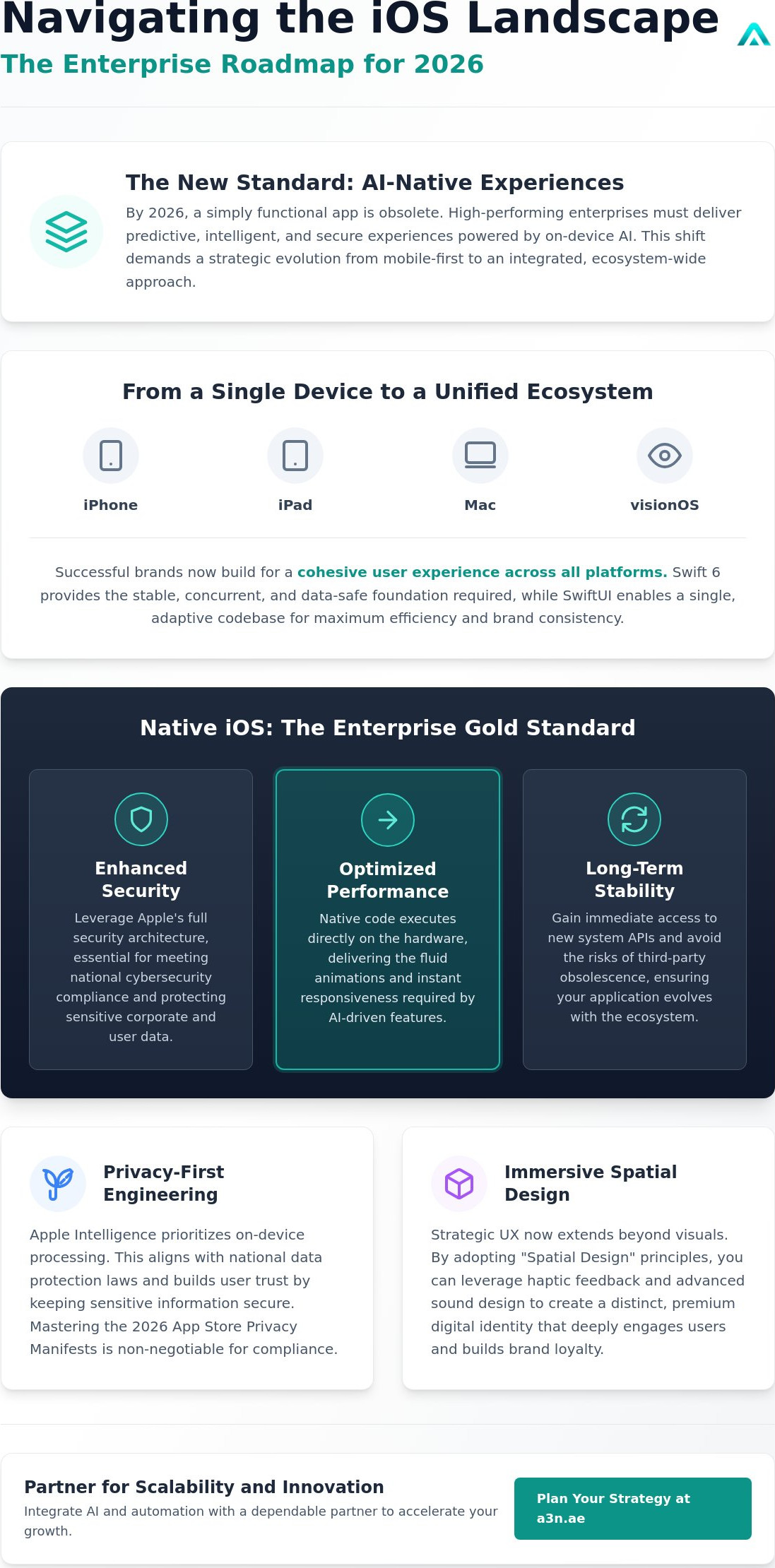
In 2026, the definition of iOS app development has expanded far beyond the confines of a handheld device. It's now a comprehensive ecosystem-wide strategy that integrates iPhone, iPad, Mac, and the spatial computing capabilities of visionOS into a single, cohesive experience. National brands are moving away from fragmented digital presences. They're opting instead for a unified approach that ensures brand consistency across every touchpoint. This evolution is driven by the maturation of Swift 6, which has introduced groundbreaking advancements in data safety and concurrent programming. For enterprises, this means more stable applications that can handle complex, simultaneous tasks without the risk of system crashes or data corruption.
The development lifecycle itself has undergone a fundamental shift from mobile-first to AI-first. Successful strategies now prioritize how Apple Intelligence can proactively serve the user before they even initiate a command. This transition requires a deep understanding of the iOS Software Development Kit (SDK) to leverage on-device processing power effectively. We see national brands returning to native roots because the performance demands of 2026's AI-native features simply cannot be met by generic, cross-platform wrappers. Native engineering ensures that your application remains responsive while executing heavy machine learning models locally on the device.
The Shift Toward Unified Apple Platforms
SwiftUI is the declarative standard for modern Apple interfaces, enabling developers to build sophisticated UI components that adapt fluidly across the entire product lineup. By utilizing a unified codebase, national brands can scale their reach with remarkable efficiency. This approach reduces the overhead of maintaining separate logic for different devices while ensuring that the user experience remains premium and familiar. It's a strategic move that allows businesses to deploy innovations faster and maintain a competitive edge in a crowded market. A single engineering effort can now power a presence on the wrist, in the pocket, and through the headset.
Why Native iOS Development Remains the Enterprise Gold Standard
While cross-platform tools offer a tempting shortcut, they often struggle to keep pace with Apple's rapid release cycles. Native iOS app development provides immediate access to the latest system APIs, ensuring that your application can utilize new hardware features the moment they debut. This deep system integration is vital for high-traffic corporate apps that require maximum performance and reliability.
- Optimized Performance: Native code executes directly on the hardware, providing the fluid animations and responsiveness users expect from a premium brand.
- Enhanced Security: Native apps benefit from the full weight of Apple's security architecture, which is critical for national cybersecurity compliance.
- Long-term Stability: Staying within the native ecosystem simplifies maintenance and reduces the risk of third-party library obsolescence.
Building natively isn't just a technical choice; it's a commitment to quality and institutional longevity. It allows your organization to take full ownership of the technical landscape, ensuring that your digital tools grow alongside your business without the friction of platform limitations.
Apple Intelligence and the Rise of AI-Native iOS Applications
Apple Intelligence has fundamentally altered the consumer's relationship with their devices. In 2026, users no longer search for features; they expect them to surface contextually. This integration of artificial intelligence transforms iOS app development from a reactive process into a predictive one. By leveraging the local compute power of the iPhone, brands can offer hyper-personalized experiences that feel intuitive rather than intrusive. This approach builds a deep sense of trust, as sensitive user data never leaves the device, satisfying both the consumer’s desire for privacy and the enterprise's need for security. Core ML now serves as the engine for real-time data processing, allowing for sophisticated pattern recognition without the lag of cloud round-trips.
Leveraging App Intents for System-Wide Visibility
The 2026 Siri interface acts as a proactive concierge, and App Intents are the keys to this gateway. By defining clear intents, your brand's services become discoverable through natural language queries and Spotlight searches. For a fintech application, this means a user can check their balance or authorize a payment via a simple voice command without ever opening the app. Logistics firms use these intents to automate complex business processes through Shortcuts, allowing drivers to update delivery statuses or route information through hands-free interactions. This level of system-wide visibility ensures your services remain at the center of the user's digital life, driving engagement through sheer utility.
On-Device Machine Learning vs. Cloud AI
Strategic decision-making in 2026 requires a clear framework for data processing. While cloud-based models offer massive scale, on-device machine learning provides the speed and privacy required for real-time interactions. Utilizing Apple’s Neural Engine significantly reduces operational costs by offloading processing tasks to the user's hardware. It eliminates the latency associated with server requests, providing an instantaneous feel that defines premium digital products. If you're looking to modernize your current stack, exploring AI & automation solutions can help you determine which features benefit most from this local execution.
The general rule for 2026 engineering is simple: keep personal, high-frequency, and low-latency tasks on-device. Reserve the cloud for massive data aggregation or collaborative features that require global state. This hybrid model ensures your iOS app development strategy remains scalable and secure. It protects your brand from the volatility of cloud processing fees while maximizing the performance of the latest Apple silicon. By prioritizing on-device execution, you demonstrate a commitment to both technical excellence and user data sovereignty.
Privacy-First Engineering and National Cybersecurity Compliance
Privacy-first engineering is no longer an optional feature; it's the bedrock of institutional trust for every national brand in 2026. As Apple tightens its ecosystem, iOS app development must now bridge the gap between global technical standards and specific national cybersecurity frameworks. This alignment ensures that your digital assets remain both functional and legally resilient. In 2026, Apple requires every application to provide exhaustive Privacy Manifests that detail exactly why each piece of data is collected. These manifests aren't just technical hurdles. They're opportunities to demonstrate a commitment to data sovereignty and user protection.
Staying ahead of iOS App Development Trends in 2026 requires a proactive stance on security that goes beyond mere compliance. Many enterprises worry that strict privacy rules will blind their business analytics. However, modern engineering allows for high-level insights through privacy-preserving technologies like Differential Privacy and aggregated data reporting. By implementing these methods, you can gather the necessary business intelligence to drive growth without compromising the "privacy-pure" status of your application. This approach satisfies both the internal need for data-driven decisions and the external requirement for user anonymity.
Navigating National Data Sovereignty in the App Store
National brands must carefully manage where their data lives. While global cloud providers offer immense scale, localizing sensitive data storage within regional borders is often a legal necessity. We recommend a hybrid architecture that utilizes global infrastructure for non-sensitive assets while keeping core user data within national boundaries. Regular regional cybersecurity audits have become standard practice for enterprise apps to verify this separation. Implementing end-to-end encryption is the absolute gold standard for ensuring data integrity in national fintech and government-facing applications.
Implementing Privacy Manifests and Nutrition Labels
Transparency is the most effective way to build long-term brand trust. Developers should follow a rigorous checklist to ensure all third-party SDKs are accounted for within the App Store’s "Nutrition Labels." Non-compliance in 2026 doesn't just lead to rejection; it results in significantly reduced visibility in search results and irreparable damage to your brand’s reputation. To maintain your standing, consider the following steps:
- SDK Auditing: Review every third-party library to ensure they comply with your internal privacy standards.
- User Communication: Use clear, non-technical language to explain the value of data collection within the app UI.
- Advanced Data Protection: Enable Apple’s latest encryption protocols for corporate users to safeguard sensitive business communications.
By taking full ownership of the privacy landscape, your organization can focus on scaling its services with the confidence that its technical foundation is secure. This proactive engineering protects your users and positions your brand as a stable, reliable leader in the digital economy.
Strategic UX: Beyond Visuals to Immersive Ecosystem Integration
User experience in 2026 has transcended the traditional screen. Modern iOS app development now draws heavily from "Spatial Design" principles originally pioneered for visionOS. These influences introduce depth, layered hierarchies, and realistic materials into mobile interfaces, creating a sense of physical presence that static designs cannot match. National brands are recognizing that a "premium" digital identity requires a multisensory approach. Sophisticated haptic feedback and custom sound design provide immediate, tactile confirmation of user actions, reinforcing a sense of quality and reliability with every tap. These elements don't just decorate an interface; they build institutional trust through consistent, high-fidelity interactions.
Live Activities and the Dynamic Island have evolved from novelties into essential conduits for real-time communication. They allow enterprises to maintain a persistent but non-intrusive presence on the user's device, providing critical updates without requiring the app to be fully open. For businesses looking to redefine their digital footprint, our UI/UX design services focus on creating these seamless, ecosystem-wide integrations. By prioritizing these glanceable interactions, you respect the user's attention while ensuring your brand remains indispensable throughout their daily journey.
The Evolution of the Dynamic Island and Live Activities
The Lock Screen has effectively become the new primary interface for quick, high-value interactions. Logistics and service-based applications now use Live Activities to provide real-time tracking for deliveries or service arrivals directly on the always-on display. This shift requires a delicate balance of information density. You must provide enough detail to be useful while avoiding cognitive overload. Successful 2026 strategies treat the Dynamic Island as an active status bar. It allows users to monitor background tasks like payment processing or file uploads while remaining productive in other areas of the system.
Inclusive Design for National Audiences
True market leadership requires a commitment to universal access. Accessibility (A11y) isn't just a niche requirement; it's a driver for broader market reach and legal compliance. Effective iOS app development must account for a wide spectrum of user needs, from high-contrast modes to full VoiceOver and AssistiveTouch support. This inclusivity extends to hardware diversity as well. While the latest iPhone models offer immense power, national brands must ensure their software remains performant on older devices still prevalent in the market. Localization strategies should look beyond simple language translation to address cultural nuances in UI patterns and imagery, ensuring the brand feels natively familiar to every segment of the national audience.
Partnering for Scalability: The A3N Approach to iOS Innovation
A3N positions itself as the strategic architect for organizations ready to lead through technical excellence. In an era where iOS app development requires more than just functional code, we provide the visionary guidance necessary to build future-ready systems. Our team specializes in the seamless integration of AI and automation into your existing mobile workflows, ensuring that Apple Intelligence serves as a catalyst for efficiency rather than a source of complexity. We take full ownership of the technical landscape, allowing your leadership to focus on broader growth objectives while we maintain the stability and performance of your digital infrastructure.
Scaling a national project demands a flexible approach to talent and resources. Our staff augmentation services allow you to rapidly expand your internal capabilities with specialized experts who understand the nuances of the 2026 Apple ecosystem. This model provides the agility required to meet aggressive deadlines without the long-term overhead of permanent hiring. Every project we undertake is grounded in a deep commitment to cybersecurity and cloud infrastructure integrity, protecting your institutional data against the evolving threats of the digital age. We don't just build apps; we engineer secure foundations for long-term growth.
From Concept to App Store: Our Full-Lifecycle Support
The Apple review process for national brands involves navigating complex compliance standards and technical requirements. A3N manages this journey from initial architecture to final approval, ensuring your application meets all regulatory and quality benchmarks. Beyond the launch, we implement robust maintenance and optimization strategies to keep your software performant through 2026 and into the future. It's a partnership that extends far beyond the initial release. Explore our Mobile App Development services to see how we can streamline your path to the App Store.
Building Secure and Scalable Mobile Ecosystems
A successful mobile strategy doesn't exist in a vacuum. We specialize in integrating mobile applications with custom ERP systems and cloud solutions to create a unified data environment. This connectivity ensures that your app is a powerful tool for business intelligence and operational control. Our approach to UI/UX design focuses on driving national engagement through interfaces that are both culturally resonant and technically superior. We ensure your iOS app development efforts contribute directly to your organization's scalable success. If you're ready to transform your mobile presence, consult with A3N for your next iOS project.
Engineering the Future of National Mobile Strategy
Success in 2026 depends on your ability to synthesize Apple's rapid technical innovations with the complex demands of national security and user privacy. We've explored how Apple Intelligence and Swift 6 are redefining the standards for enterprise performance and how spatial design principles are creating more immersive brand identities. These shifts represent a fundamental reimagining of the digital relationship between a brand and its audience. Navigating these changes requires a partner who views iOS app development not just as a service, but as a core component of your long-term growth strategy.
A3N stands ready as your strategic architect in this evolving landscape. Our dedicated UI/UX design team creates immersive experiences that resonate culturally, while our deep expertise in AI & automation solutions ensures your systems remain at the cutting edge of efficiency. By prioritizing comprehensive cybersecurity integration, we protect your institutional data and build the enduring trust your users demand. It's time to transform these technological trends into a tangible competitive advantage for your organization.
Partner with A3N for Visionary iOS Development
We look forward to helping you build a resilient and innovative digital presence that defines the standard for your industry.
Frequently Asked Questions
Is native iOS app development better than cross-platform in 2026?
Native engineering remains the superior choice for enterprises that prioritize performance and deep system integration. It provides immediate access to the latest Apple Intelligence APIs and ensures your software can utilize the full power of the device's hardware without the limitations of third-party wrappers. This approach is essential for high-traffic applications that require maximum stability and a premium user experience.
How much does it cost to develop an enterprise iOS app in the UAE?
The investment required for a corporate application depends on several factors, including functional complexity, the depth of AI integration, and specific cybersecurity requirements. National brands often face unique costs related to data localization and regulatory compliance. We recommend a detailed consultation to establish a project scope that aligns with your specific business objectives and technical standards.
What is Apple Intelligence and how can my business use it?
Apple Intelligence is a suite of on-device AI tools designed to provide predictive and personalized user experiences. Your business can use these features to automate routine workflows, offer context-aware suggestions, and improve customer support through natural language processing. By utilizing on-device execution, you can provide these advanced capabilities while maintaining the highest levels of user data privacy.
How long does the iOS app development process typically take?
The timeline for iOS app development varies based on the scale of the project and the complexity of existing system integrations. A standard enterprise lifecycle moves through architectural planning, UI/UX design, engineering, and rigorous security testing. Methodical planning ensures that each phase contributes to a stable and scalable final product that meets the strict standards of the App Store.
Do I need a separate app for iPad and iPhone in 2026?
You don't need distinct projects for different devices thanks to the maturation of SwiftUI. This declarative framework allows for a unified codebase that fluidly adapts its interface to fit iPhones, iPads, and even Macs. This strategy reduces long-term maintenance overhead and ensures that your brand identity remains consistent across the entire Apple ecosystem.
How does A3N ensure my iOS app complies with national cybersecurity standards?
We integrate comprehensive cybersecurity solutions into the very foundation of your application. This includes implementing end-to-end encryption, configuring local data storage to meet sovereignty laws, and conducting regular audits. Our team takes full ownership of the technical landscape to ensure your mobile presence remains a secure and stable asset for your organization.
Can I integrate my existing AI models into a new iOS application?
Yes, Apple's Core ML framework allows you to convert and deploy various machine learning models directly onto the device. This capability enables you to leverage your existing intellectual property while benefiting from the speed and privacy of local execution. It's an efficient way to bring custom business intelligence into a mobile environment without starting from scratch.
What is the role of Swift 6 in 2026 iOS development?
Swift 6 is the essential foundation for modern, safe, and concurrent programming in 2026. It introduces strict data-safety protocols that prevent common coding errors, leading to more resilient enterprise applications. By adopting Swift 6, your iOS app development team can build sophisticated features that handle multiple tasks simultaneously without risking system crashes or data corruption.