


We're here to help you master this landscape by providing a strategic roadmap for building compliant-by-design technical infrastructure. You'll gain the confidence to scale your operations without the fear of regulatory friction or reputational damage. This guide breaks down the shift toward mandatory frameworks like the Information Assurance Standard Version 2.1 and Dubai ISR V3, offering a clear path to national compliance that secures your growth in a rapidly changing digital environment.
Key Takeaways
- Understand the shift from reactive security to the proactive national resilience mandated by the UAE Digital Government Strategy 2025-2030.
- Identify the core technical requirements within NESA IAS v2.1 and Dubai ISR V3 to ensure your UAE cybersecurity compliance remains ahead of evolving federal standards.
- Learn how to integrate security protocols directly into your software development life cycle to create naturally resilient digital assets.
- Discover the strategic role of UI/UX design in mitigating human error and preventing social engineering through intuitive, secure user interfaces.
- Access a methodical five-step roadmap for executing comprehensive risk assessments and scaling your technical infrastructure securely.
Table of Contents
The Evolution of UAE Cybersecurity Compliance in 2026
The United Arab Emirates has fundamentally transformed its approach to digital safety, moving decisively away from a reactive model toward a framework of proactive national resilience. This shift ensures that the nation's digital economy isn't just protected against current threats but is architected to withstand the challenges of tomorrow. Central to this transformation is the UAE Cyber Security Council, which now orchestrates the standards that every modern enterprise must follow. By 2026, the era of voluntary adherence has largely concluded. Even non-critical sectors are now subject to mandatory auditing, marking a significant pivot in how UAE cybersecurity compliance is enforced across the private sector.
This strategic evolution is heavily influenced by the UAE Digital Government Strategy 2025-2030. This initiative envisions a seamless, secure digital experience that requires organizations to integrate security requirements into the very fabric of their technical infrastructure. Businesses are no longer merely protecting their own silos; they're active participants in a collective defense of the nation's digital borders. The Signals Intelligence Agency (SIA), which oversees the foundational Information Assurance Standards, continues to refine these protocols to address the sophisticated AI-driven threats that define the 2026 landscape. Success in this environment requires a partner who understands that security is a catalyst for innovation rather than a barrier to it.
The Economic Impact of Non-Compliance
Financial penalties under federal law are substantial, yet they represent only the visible portion of the risk. For enterprises operating in the Emirates, reputational damage can be far more devastating. A single breach can erode years of brand equity in a market that prizes stability and trust. Beyond reputation, your compliance status directly dictates your commercial growth. Government entities now require verified proof of high-level security maturity before awarding contracts. Additionally, institutional investors increasingly view robust UAE cybersecurity compliance as a primary indicator of operational excellence and long-term viability. If you don't prioritize these standards, you're effectively limiting your ability to scale within the region.
Global Standards vs. UAE National Requirements
Many organizations mistakenly assume that an ISO 27001 certification or GDPR readiness is sufficient for local operations. While these global benchmarks provide a strong foundation, they don't fully address the specific mandates of UAE Federal Law No. 45 of 2021 regarding personal data protection. The UAE's requirements for data sovereignty and residency are particularly stringent. Local regulations often require that specific categories of data remain within national borders, a nuance that international frameworks may overlook. We help you bridge this gap by aligning your technical architecture with these local standards, ensuring your growth remains uninterrupted by regulatory friction.
Core Frameworks: NESA, ISR, and Federal Data Protection
Achieving robust UAE cybersecurity compliance requires a deep understanding of the interlocking frameworks that govern the nation's digital space. These regulations aren't isolated rules; they're a cohesive ecosystem designed to protect national interests while fostering commercial growth. For any modern enterprise, the journey begins with NESA and the Information Security Regulation (ISR), which provide the technical and organizational blueprints for entity-level protection. These standards ensure that every layer of your operation, from physical servers to cloud-based applications, adheres to a unified security posture.
NESA Compliance for the Private Sector
NESA serves as the primary framework for UAE digital resilience, establishing the baseline for national information security. The National Electronic Security Authority’s Information Assurance Standard (IAS) consists of 188 security controls divided into technical and management categories. We help you identify which of these controls are mandatory based on your organization's classification within the national infrastructure. This tiered approach allows for a scalable implementation, ensuring that while the most critical entities meet the highest rigors, smaller enterprises can build a sustainable security foundation without operational paralysis.
Beyond these general standards, sector-specific mandates add layers of complexity. Healthcare providers must navigate the Abu Dhabi Health Information and Cyber Security (ADHICS) standard, while licensed financial institutions are governed by the Central Bank of the UAE (CBUAE) frameworks. These regulations demand precise technical execution. Our cybersecurity solutions are designed to integrate these varied requirements into a single, manageable architecture, allowing you to focus on your core business objectives.
Cloud and AI Residency Requirements
By 2026, the rules surrounding data residency have become remarkably specific, particularly concerning AI and automation solutions. National data sovereignty is a non-negotiable priority. Sensitive national data and personal information must be stored and processed within UAE-compliant data centers. This requirement extends to the training of AI models; any automation system processing the data of UAE residents must ensure that the data lifecycle remains within national borders unless explicit cross-border transfer approval is granted by the relevant authorities.
-
Data Sovereignty: All sensitive personal data must reside on servers physically located within the UAE.
-
AI Processing: Automation workflows must handle data locally to prevent unauthorized international exposure.
-
Transfer Approvals: Cross-border data movement requires a rigorous technical assessment and formal authorization under Federal Decree-Law No. 45 of 2021.
Managing these residency requirements doesn't have to stifle your technological advancement. It simply requires a sophisticated architectural approach that prioritizes local cloud environments and edge computing. By aligning your AI initiatives with these residency mandates, you don't just achieve UAE cybersecurity compliance; you build a future-ready system that respects the privacy of your users and the security of the nation.
Compliance-by-Design: Building Secure Custom Software
Technical architecture is the silent engine of regulatory adherence. While legal frameworks provide the "what," your software’s underlying code determines the "how" of UAE cybersecurity compliance. We believe that security must be an intrinsic part of the Software Development Life Cycle (SDLC) rather than a final layer added before launch. By shifting security to the earliest stages of planning, enterprises can build resilient systems that naturally align with national standards. This "compliance-by-design" approach ensures that every feature, from user authentication to data processing, is architected to withstand the sophisticated threat landscape of 2026.
Bespoke solutions offer a significant advantage over off-the-shelf software when navigating the Emirates' specific regulatory landscape. Custom Website & Software Development allows for the implementation of precise encryption standards, such as AES-256 for data at rest and TLS 1.3 for data in transit, which are often mandated for UAE mobile and web applications. Unlike generic platforms that may have hidden vulnerabilities or rigid data handling processes, tailored software gives you granular control over how sensitive information is stored, accessed, and moved across your digital ecosystem.
Our approach to UI/UX Design also plays a pivotal role in maintaining a secure environment. Human error remains a leading cause of data breaches; however, intuitive design can significantly mitigate this risk. By creating clear, secure workflows and implementing multi-factor authentication that doesn't frustrate the user, we reduce the likelihood of social engineering success. A well-designed interface guides users toward secure behaviors, making compliance a seamless part of the digital experience rather than a burdensome hurdle.
Architecting for Data Integrity
Maintaining data integrity requires a sophisticated approach to backend infrastructure. We utilize database sharding to distribute sensitive national data across multiple secure environments, which limits the potential impact of a localized breach. API security is equally critical. We protect these digital gateways through rigorous authentication protocols and rate limiting to prevent unauthorized access. Regular secure code reviews and automated vulnerability scanning are integrated into our development pipeline, ensuring that potential weaknesses are identified and remediated before they can be exploited.
AI and Automation Security
As enterprises adopt AI & Automation Solutions, the security of the underlying models becomes paramount. Achieving UAE cybersecurity compliance in 2026 requires absolute transparency in AI decision-making processes. We focus on securing the training data sets used for custom AI models, ensuring they're free from bias and protected from adversarial attacks. By validating every automated business process through a security lens, we help you leverage the power of automation while maintaining the high levels of accountability required by UAE federal law. This proactive stance allows you to innovate with confidence, knowing your technical foundation is both modern and secure.
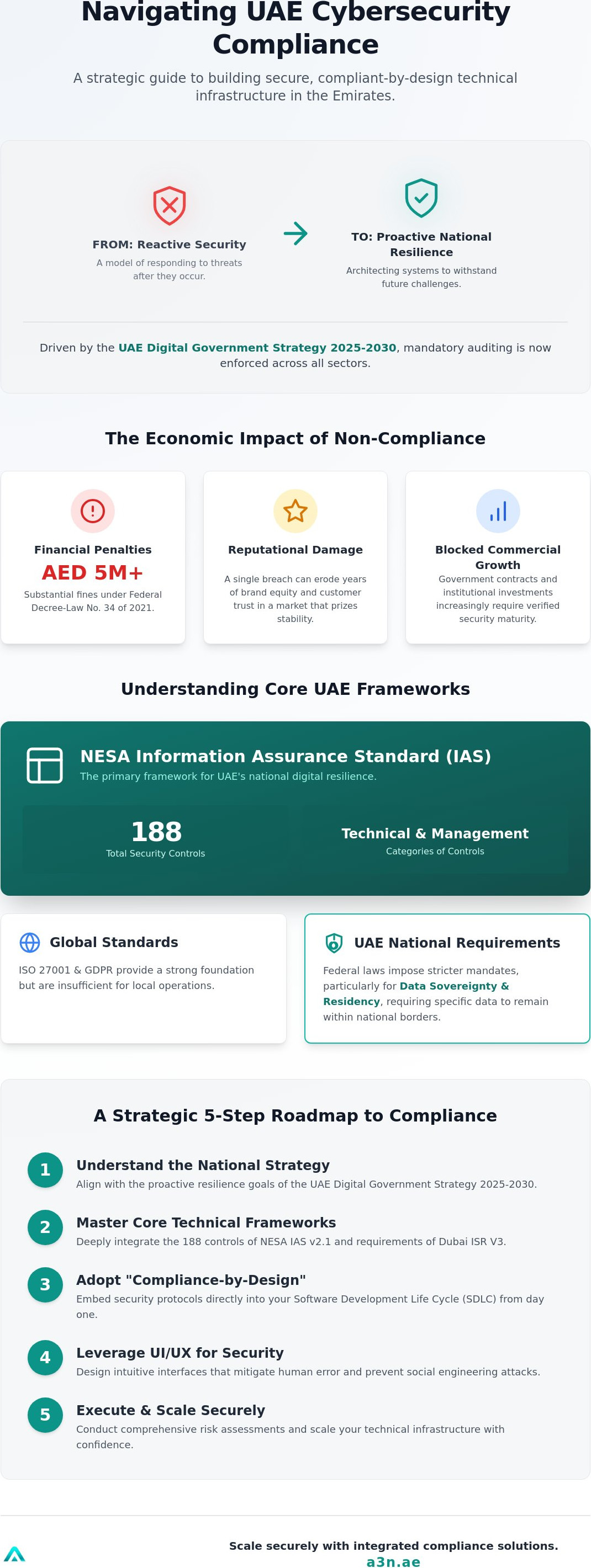
5-Step Roadmap to Achieving National Cybersecurity Compliance
Achieving UAE cybersecurity compliance isn't a one-time event; it's a continuous cycle of refinement and hardening. This journey requires a disciplined move from theoretical understanding to practical, audited execution. We've structured this process into five distinct phases that ensure every part of your enterprise is protected and prepared. By following this methodical approach, you transform a complex regulatory obligation into a streamlined operational standard that supports your long-term growth.
-
Phase 1: Comprehensive Risk Assessment and Gap Analysis. We begin by identifying the distance between your current security posture and national mandates.
-
Phase 2: Framework Selection and Policy Development. This phase involves choosing the specific standards, such as NESA or ISR, that align with your industry and drafting the governance policies to support them.
-
Phase 3: Technical Implementation and Architectural Hardening. Here, we translate policies into code and infrastructure, ensuring your systems are resilient by design.
-
Phase 4: Staff Training and Security Culture Integration. We empower your team to become your first line of defense through targeted education and awareness.
-
Phase 5: Continuous Monitoring and Third-Party Auditing. The final phase ensures ongoing adherence through automated tools and independent verification.
Conducting a National Risk Assessment
The foundation of any successful strategy is a clear-eyed evaluation of your digital landscape. You must identify critical digital assets within the UAE context, focusing on data that impacts national security or resident privacy. It's equally vital to evaluate third-party risks in your software supply chain, as vulnerabilities often enter through external integrations. A robust national risk assessment must specifically account for 2026 threat vectors, including sophisticated AI-orchestrated social engineering and the rapid exploitation of zero-day vulnerabilities in decentralized networks. This proactive identifying of weaknesses allows you to prioritize your resources effectively.
Technical Hardening and Implementation
Once risks are identified, the focus shifts to architectural hardening. This involves deploying multi-factor authentication (MFA) across all entry points and adopting a zero-trust architecture where no user or device is trusted by default. We recommend automating compliance monitoring through cloud-native tools that provide real-time visibility into your security status. This automation reduces the burden on your internal teams and ensures that deviations from UAE cybersecurity compliance are flagged instantly.
For many enterprises, the primary challenge is finding the specialized talent required to execute these complex technical changes. Leveraging our Staff Augmentation services allows your organization to bridge these specialized security gaps without the overhead of long-term recruitment. This ensures your defense remains agile, expert-led, and fully aligned with the latest federal requirements. By integrating external expertise into your existing workflows, you can accelerate your path to compliance while maintaining focus on your core business innovation.
Scaling Securely with A3N’s Integrated Compliance Solutions
Building a future-ready enterprise in the Emirates requires more than just technical proficiency; it demands a partner who anticipates regulatory shifts before they occur. At A3N, we integrate national standards into the DNA of every custom project we undertake. Whether we're delivering Website & Software Development or complex Mobile App Development, our methodology ensures that UAE cybersecurity compliance is never a secondary consideration. We take full ownership of the technical landscape, allowing your leadership to focus on ambitious growth while we maintain the integrity of your digital borders.
Our proactive approach extends to the most advanced frontiers of technology. We specialize in AI & Automation Solutions and Blockchain Development that are architected specifically for the UAE's high-security environment. By securing the training data for AI models and leveraging the immutable nature of blockchain for data integrity, we help you deploy cutting-edge tools without compromising on national safety requirements. This strategic alignment with the local regulatory pulse ensures your digital transformation is as stable as it is innovative.
Leveraging our expertise allows you to navigate the complexities of 2026's digital mandates with total clarity. We don't just offer services; we provide a sophisticated architectural framework that streamlines your path to UAE cybersecurity compliance. By entrusting your technical foundation to a visionary guide, you gain the freedom to scale your operations securely across the national and global market.
Beyond Implementation: A Reassuring Partnership
We believe that a successful digital journey is defined by the quality of the partnership behind it. Our commitment goes beyond the initial deployment phase. We provide continuous support and updates as UAE regulations evolve, ensuring your systems remain resilient against emerging threats. Through transparent communication and dedicated expert guidance, we position your business as a leader in digital trust. You'll have the confidence of knowing a sophisticated architect is managing your security posture around the clock, providing a stable force in a rapidly changing environment.
Start Your Secure Digital Journey
Security is a fundamental component of the user experience. Our UI/UX Design and development teams prioritize safety at every touchpoint, creating interfaces that guide users toward secure behaviors naturally. We've delivered numerous compliant-by-design enterprise solutions that have successfully navigated the rigors of national auditing and high-stakes data residency requirements. By leveraging our deep expertise, you can accelerate your path to digital maturity while ensuring every asset is hardened against unauthorized access. Consult with our experts to secure your UAE digital assets and build a legacy of reliability in the region's digital economy.
Securing Your Enterprise Legacy in the Emirates
The transition toward a proactive national resilience model has redefined the standards of digital excellence. You've seen how integrating security into the very fabric of your technical architecture isn't just a legal necessity but a strategic advantage that fosters investor confidence and protects your corporate reputation. By adopting a methodical roadmap and leveraging frameworks like NESA and ISR, your organization can transform regulatory pressure into a streamlined engine for growth. Mastering UAE cybersecurity compliance is the cornerstone of sustainable digital expansion in 2026 and beyond.
A3N serves as your visionary guide in this complex environment. We bring deep expertise in the UAE Federal Data Protection Law and deploy specialized AI and blockchain security protocols to safeguard your most critical assets. Our national coverage ensures that your enterprise-grade systems remain resilient across every emirate. We take full ownership of your technical landscape so you can focus on scaling your vision with absolute peace of mind. Partner with A3N for secure, compliant software development and build a foundation of digital trust that endures. Your secure future starts with a single, strategic step forward.
Frequently Asked Questions
What are the penalties for non-compliance with the UAE Data Protection Law?
Fines for non-compliance with federal cybersecurity regulations can range from AED 100,000 to over AED 5 million. These financial penalties are often accompanied by criminal charges under Federal Decree-Law No. 34 of 2021. Beyond the immediate monetary impact, organizations face severe reputational damage and the loss of eligibility for lucrative national government contracts.
Does my small business need to comply with NESA standards?
Yes, small businesses must increasingly adhere to NESA standards as the UAE moves toward mandatory compliance for all sectors by 2026. While the most rigorous controls are prioritized for critical infrastructure, every entity processing national data is expected to maintain a baseline level of security. Implementing these standards early protects your business from future legal friction and positions you as a trusted partner in the national digital ecosystem.
How does UAE cybersecurity compliance affect cloud migration?
UAE cybersecurity compliance mandates that sensitive national data and personal information must be stored within UAE-compliant data centers. This requires organizations to prioritize local cloud providers or edge computing solutions rather than relying solely on international servers. Your migration strategy must include a rigorous technical assessment to ensure that data residency and encryption standards align with federal requirements before any assets are moved.
What is the difference between ISR and NESA frameworks?
The primary difference lies in their jurisdiction and scope; NESA is a federal framework while ISR is specific to Dubai government entities and their partners. NESA focuses on national electronic security and critical infrastructure protection across all emirates. In contrast, the Information Security Regulation (ISR) V3 provides a detailed set of pillars for entity-level protection within the Dubai government’s digital environment.
Can I store UAE customer data on international servers in 2026?
Storing UAE customer data on international servers is generally prohibited unless you obtain explicit approval and meet strict cross-border transfer requirements. Federal Decree-Law No. 45 of 2021 emphasizes data sovereignty, requiring that personal data remain within national borders to ensure resident privacy. Organizations must verify that their technical architecture uses local data centers to maintain full compliance with these evolving residency mandates.
How often should a UAE-based firm conduct a cybersecurity audit?
Most UAE-based firms should conduct a comprehensive cybersecurity audit at least once a year, though high-risk sectors may require more frequent assessments. For example, licensed financial institutions face a deadline of June 30, 2026, to conduct their first digital impersonation risk assessment. Regular auditing ensures that your security controls evolve alongside new threats and that you remain prepared for mandatory federal inspections.
What role does AI play in modern UAE cybersecurity compliance?
AI serves as both a tool for automated compliance monitoring and a subject of strict regulatory oversight regarding data processing. Modern systems use AI to detect vulnerabilities in real-time and streamline the reporting of potential incidents to the UAE Cyber Security Council. However, your custom AI models must be transparent and secure, ensuring that the training data and decision-making processes adhere to national residency and accountability standards.
How can custom software development improve my compliance posture?
Custom software development allows you to integrate specific UAE cybersecurity compliance requirements directly into the application’s core architecture. Unlike off-the-shelf products, bespoke solutions provide granular control over data handling and API security, ensuring that every feature is compliant-by-design. This approach eliminates the hidden vulnerabilities often found in generic software and allows your technical infrastructure to scale securely as regulations evolve.